
Separating extraction, calculation, and professional judgment
Finsider Labs / Updated September 12, 2026 / 3 min read
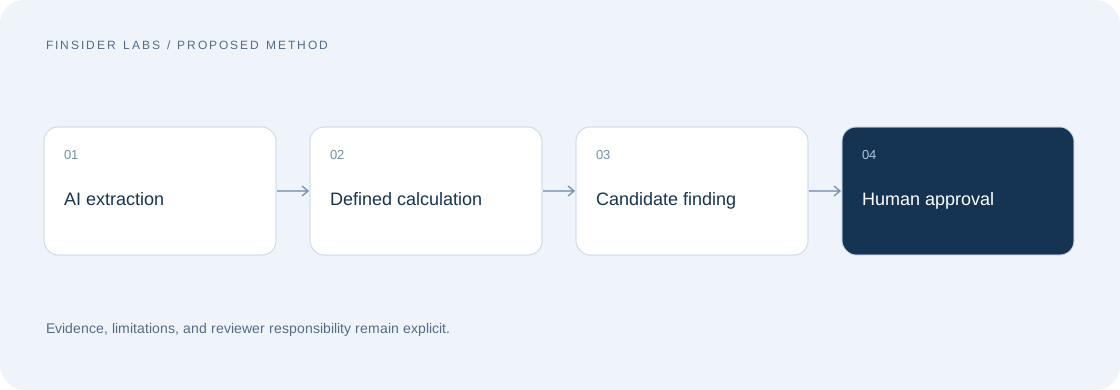
Reliable financial work needs explicit boundaries between reading a document, computing a value, proposing an interpretation, and approving a conclusion.
Research question
What evidence and control boundaries make professional review meaningful in an AI-assisted financial workflow? This note proposes a responsibility model; it does not measure the accuracy of a particular model or agent.
Separate four responsibilities
Extraction identifies what a source says. Calculation derives a result from selected inputs. Interpretation proposes what the result means. Approval records a responsible reviewer's decision. Each stage should expose its inputs and limitations instead of inheriting apparent certainty from the preceding stage.
Design the review gate
Give the reviewer the source location, calculation, candidate rationale, missing evidence, and proposed action. Make accept, reject, and request-evidence outcomes explicit. Retain changes and the prior state. For actions with external consequences, such as releasing a deliverable, define who can authorize them and what must be complete first.
Proposed evaluation
Use cases with deliberately wrong extractions, correct arithmetic on wrongly mapped inputs, unsupported explanations, and attempts to deliver pending findings. Measure whether reviewers can locate evidence and whether release controls block incomplete states. Track false blocks separately from missed blocks. Human agreement is not assumed to be perfect ground truth. No experimental results or error-elimination claim is made.
Product boundary
Finsider uses AI agents to assist the financial workflow while keeping professional judgment separate. Platform supports work reviewed by the customer's team. Advisory combines an AI-powered workflow with CPA review and sign-off for the agreed deliverable. Addback is an initial screen, not an automatically signed professional opinion.
A proposed responsibility matrix
Illustrative example / not empirical results
| Work item | Software contribution | Required reviewer action |
|---|---|---|
| Extract a value | Locate and transcribe source content | Verify material values against the source |
| Calculate a metric | Run versioned logic on identified inputs | Review mapping, scope, and exceptions |
| Suggest an adjustment | Surface a candidate and rationale | Accept, reject, or request evidence |
| Deliver a conclusion | Assemble the reviewed output | Authorize delivery within the agreed engagement |
Sources and context
These sources inform the discussion. They do not validate Finsider product performance or the proposed method.
Generative systems can confidently produce erroneous content. Fluent output alone is not verification.
The framework calls for differentiated human-AI responsibilities and oversight. It does not endorse or certify Finsider.