
Why evidence lineage matters in financial diligence
Finsider Labs / Updated September 12, 2026 / 3 min read
A financial finding becomes useful when another reviewer can reconstruct its source, calculation, assumptions, and decision.
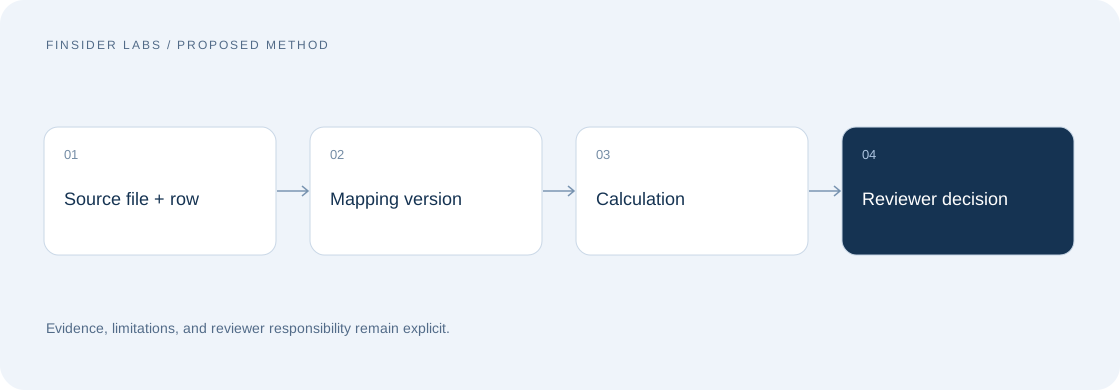
Preserve the source
Financial diligence depends on a chain of evidence. A reported metric may pass through an accounting export, a normalization step, a calculation, and an adjustment before appearing in a deliverable. Each step changes what a reviewer needs to understand.
Preserve the identity of the source file, the relevant row or document location, the entity, and the analysis period. Similar filenames or repeated exports are not enough to establish that two reviewers are looking at the same evidence.
Make transformations visible
Normalization should make records easier to analyze without erasing their origin. Mapping a ledger account into a financial category is a transformation that should remain understandable to the person reviewing the result.
Distinguish source values from calculated values. A financial figure copied from an accounting export is not the same kind of evidence as a metric derived from several transactions or a proposed management adjustment.
For a material calculation, document the inputs, period, treatment of missing values, and relevant exclusions. A total that reconciles does not by itself establish that the selected inputs are appropriate.
Review the calculation and the judgment
A reproducible calculation can still support the wrong interpretation. Review the business context, accounting treatment, and economic substance separately from the arithmetic.
Candidate addbacks need both numerical support and a rationale. Retain the original expense, proposed adjustment, supporting documents, and reviewer decision rather than overwriting the historical record with an adjusted result.
Evidence gaps should remain visible through handoffs. If bank statements cover only part of the analysis period, a downstream summary should not imply that a full-period cash proof has been completed.
Carry context into delivery
Exports should communicate the material assumptions and limits of the work. A reader should be able to distinguish a screened question, a reviewed adjustment, and an unresolved item.
Addback retains source hashes and row citations in its derived reports. Finsider Platform and Advisory provide different levels of support for taking the financial work further; confirm the scope and evidence requirements of the workflow you choose.
This note describes an evidence-lineage framework for discussion and implementation. It does not claim a measured error reduction, certification, or completed external validation.
A minimal lineage record
Illustrative example / not empirical results
| Field | Illustrative value | Why retain it |
|---|---|---|
| Source reference | ledger.csv, row 42, retained file hash | Identify the input without relying on its display name |
| Transformation | Account map v3; period filter Jan-Dec | Explain which records entered the result |
| Derived output | Candidate ADJ-07 | Keep the candidate separate from reported books |
| Review event | Returned for supporting invoice | Preserve disagreement and unresolved evidence |
Sources and context
These sources inform the discussion. They do not validate Finsider product performance or the proposed method.
The provenance model distinguishes entities, activities, and responsible agents. The financial record design here is Finsider's proposed application, not a claim of PROV certification.