
Keeping professional judgment in AI-assisted financial diligence
Finsider Labs / Updated September 12, 2026 / 3 min read
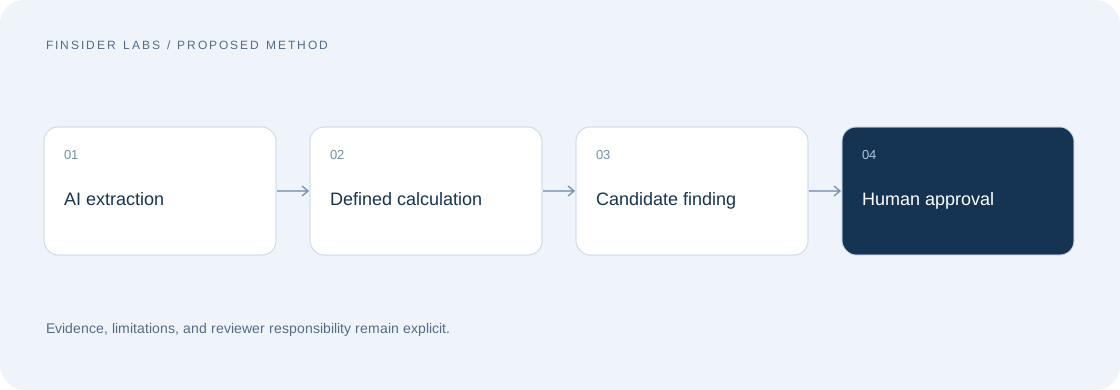
Reliable financial work needs explicit boundaries between reading a document, computing a value, proposing an interpretation, and approving a conclusion.
Separate the kinds of work
AI-assisted diligence brings several different activities into the same conversation: document extraction, deterministic calculation, anomaly identification, interpretation, and professional approval. Treating them as one undifferentiated output obscures their different risks.
Extraction asks what a source says. A scanned statement or irregular table may require a different method from a structured accounting export. The extracted value still needs a source location and, where appropriate, verification.
Use evidence as the boundary
Calculation asks how a value is derived. Financial figures should follow defined logic using identifiable inputs. A fluent explanation does not establish that the arithmetic or account mapping is correct.
Interpretation asks what the evidence means for the business and transaction. An unusual item, customer concentration, or margin movement may deserve attention without supporting a definitive adverse conclusion.
Approval is a professional decision. The reviewer must consider scope, evidence quality, accounting context, and the intended use of the deliverable before accepting a conclusion.
Design for meaningful review
Addback uses deterministic application code for the figures that drive its screening checks. Unsupported evidence is marked not assessable rather than filled with a model-generated estimate.
Where Addback uses its optional AI extraction layer, those outputs are kept separate, carry an AI origin and verification requirement, and do not replace authoritative deterministic figures.
Review should be directed at material questions, not reduced to a final checkbox. Give reviewers the source, calculation, rationale, uncertainty, and proposed next action needed to challenge a finding.
Choose an accountable workflow
Keep disagreement visible. A reviewer may reject a candidate adjustment or require additional evidence. Preserving that decision is more informative than silently changing the final number.
Finsider offers different levels of support: Addback for the first screen, Platform for work performed by your team, and Advisory for a scoped CPA-led engagement. The professional responsibilities should be clear in each workflow.
This Finsider Labs note describes a design and review framework. It does not claim that AI eliminates errors, replaces a CPA, or guarantees an investment outcome.
A proposed responsibility matrix
Illustrative example / not empirical results
| Work item | Software contribution | Required reviewer action |
|---|---|---|
| Extract a value | Locate and transcribe source content | Verify material values against the source |
| Calculate a metric | Run versioned logic on identified inputs | Review mapping, scope, and exceptions |
| Suggest an adjustment | Surface a candidate and rationale | Accept, reject, or request evidence |
| Deliver a conclusion | Assemble the reviewed output | Authorize delivery within the agreed engagement |
Sources and context
These sources inform the discussion. They do not validate Finsider product performance or the proposed method.
Generative systems can confidently produce erroneous content. Fluent output alone is not verification.
The framework calls for differentiated human-AI responsibilities and oversight. It does not endorse or certify Finsider.