
A review framework for candidate EBITDA adjustments
Finsider Labs / Updated September 12, 2026 / 3 min read
The transition from a screen to QoE begins with scope, evidence requirements, and professional judgment, not a change in the report title.
Research question
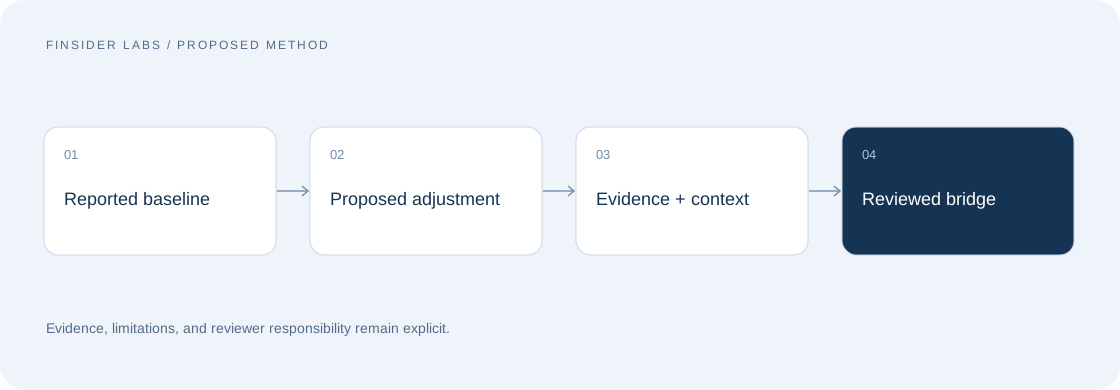
What information should accompany an EBITDA adjustment so that the engagement reviewer can accept, reject, or return it for evidence? The proposed method covers the adjustment register, not the full scope of financial due diligence.
Establish the baseline
Agree the entity, reporting basis, period, and units. Reconcile the reported earnings starting point to the available books. Define the EBITDA calculation used for the engagement rather than assuming similarly named metrics are comparable. Document unexplained differences before constructing a bridge.
Review one adjustment at a time
For each item, retain its reported-book entry, signed amount, supporting documents, management rationale, reviewer conclusion, and duplication check. Consider replacement costs and continuing obligations where an owner-related expense changes after close. Normalization may reduce earnings as well as increase them. A label such as one-time is not evidence by itself.
Proposed controls and evaluation
Use synthetic examples with known arithmetic and practitioner-reviewed cases with an explicit review rubric. Test signs, period boundaries, double counting, and exclusion of pending items. Evaluate arithmetic agreement separately from reviewer disagreement about economic treatment. Do not score every judgment difference as a software error. No benchmark or performance uplift is reported.
Delivery boundary
The reviewed bridge should identify accepted adjustments, excluded candidates, unresolved questions, and scope limits. QoE is not automatically an audit or assurance engagement. For Finsider Advisory, agree deliverables and CPA sign-off in the engagement scope; self-service screening does not carry that sign-off.
Illustrative EBITDA bridge, not a company result
Illustrative example / not empirical results
| Bridge item | Amount (USD thousands) | Treatment |
|---|---|---|
| Reported EBITDA | 1,000 | Starting point |
| Supported one-time expense | +80 | Illustrative accepted adjustment |
| Non-operating income | -30 | Illustrative accepted adjustment |
| Unsupported management proposal | 0 | Excluded pending evidence |
| Illustrative adjusted EBITDA | 1,050 | 1,000 + 80 - 30 |
Sources and context
These sources inform the discussion. They do not validate Finsider product performance or the proposed method.
Earnings normalization requires analysis of historical results and proposed adjustments, not automatic acceptance of management addbacks.
Financial due diligence considers earnings, assets, working capital, and cash flow. This is industry context, not evidence about Finsider performance.